Market volatility explained

About 7 minutes

About 7 minutes

Published 02/03/2026

Published 02/03/2026

If you're unsure what to do it’s worth looking at MoneyHelper, a free service set up by the government. You may also want to seek financial advice. There’s often a charge for this.

What’s happening?

Stock markets around the world have been experiencing some volatility – sudden sharp movements – largely driven by events in the Middle East. The launch of US and Israeli attacks on Iran and some of its allies and broader retaliatory attacks by Iran on Israel and US interests, has seen some market reaction. 

Geopolitical risks like wars, trade disputes, elections, and tensions between countries can affect financial markets in different ways. It often results in market volatility which can cause the value of your investments, including pensions, to go up or down quickly. 

The key thing to remember is that the effects of these events are usually short-lived. Markets usually recover fairly quickly.  

Investing should be for the longer-term which can help ride out any of these short-term ups and downs in value.  

What to think about

The potential benefits of staying invested

When markets take a downward turn, it’s important to avoid making impulsive decisions. It could make sense to stay invested because these ups and downs tend to balance out. You may also benefit from any potential future upturns in the stock market. However, it’s important to remember the value of investments can go down as well as up. 

Investments tend to grow overall over longer periods. So, if you take your money when the value’s dropped, you may not get back what you originally paid in.

Focusing on the long term

Investing is for the longer term. It gives you the chance to ride out any short-term movements in the value of your investments and can lead to better investment decisions rather than making kneejerk changes based on short-term market volatility.  

That long-term thinking is particularly important when it comes to pensions. When you're years away from retirement, you're likely to be investing more in shares. Shares carry more risk than other types of investment, but they have the best growth potential. 

As you get closer to retirement, your pension savings may start to move into lower-risk investments like bonds. This would mean the opportunity for growth might be lower, but so is the volatility. 

Shares tend to perform well

Although past performance isn't a reliable guide to what might happen in the future, over time, shares have historically performed better than most other types of investment, particularly bonds, which are loans to governments or companies, and cash. 

Because shares are linked to how companies' earnings perform, they can be volatile in the short term and especially when there's uncertainty around the economy. But in the long term, they tend to perform well. 

Diversification is key

When it comes to investing it’s important to not put all your eggs in one basket. Known as diversification, it means having a variety of different types of investments, like shares, bonds and property, that often react differently to economic and market changes, as well as holding investments in different countries or regions and in different types of business. 

Pensions, for example, are typically well-diversified, which can help spread your risk when things get bumpy. 

What this might mean for you

While the headlines can feel unsettling, it’s important to remember that short-term volatility is a normal part of investing. Markets have experienced similar episodes many times before and most of these events pass quickly or markets adapt to the news. If you react to each then you create your own volatility. Sticking to your investment plans and focusing on the long term means you won’t make rash decisions that could lead to losses.  

If you’re not sure what’s best for you, an independent financial adviser will be able to help. 

What’s happened in the past

If we look at the historic performance of the UK equity market, we can see how sharp falls are often short-lived. Different markets around the world will have periods of volatility, however as a rule they tend to recover over time. Download this graph: UK equity performance over time (PDF, 233KB)
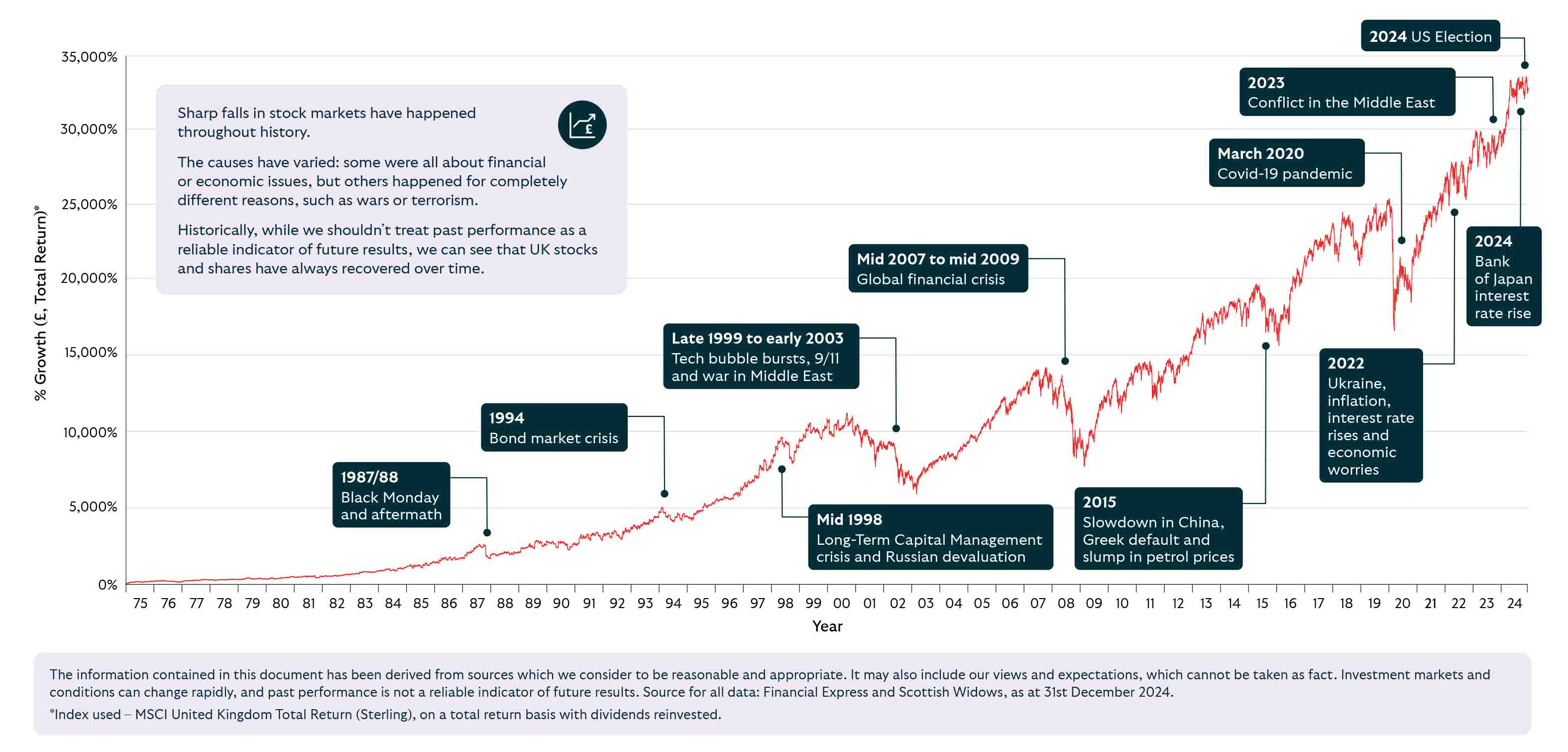
Graph showing performance of the UK equity market over time. The graph shows an overall rise in performance between 1975 and 2024, with short-term downturns caused by economic issues and other historical events.

This information has been derived from sources which we consider to be reasonable and appropriate. It may also include our views and expectations, which cannot be taken as fact. Investment markets and conditions can change rapidly, and past performance is not a reliable indicator of future results. Source for all data: Financial Express and Scottish Widows, as at 31st December 2024. *Index used – MSCI United Kingdom Total Return (Sterling), on a total return basis with dividends reinvested.

Investment markets and conditions can change rapidly, and the performance of your investments will depend on the specific investments held. These views shouldn’t be relied on when making investment decisions. If you’re not sure what to do, talk to an independent financial adviser about what’s best for you.

Find out more