You could win £10,000!
Simply download, register and use the Scottish Widows app between 7 July and 31 December 2026. For full details and eligibility, or to opt out, see our terms and conditions.

Scottish Widows responsible investment expert
The mainstream press is full of warnings about the impact of El Niño. The UK government has also issued advice linked to natural hazards and severe weather, while key waterways like the Panama Canal and the Rhine are facing restrictions on cargo size due to low water levels. But what could it mean for investors? In this article, we explore how a powerful Pacific warming event could reshape inflation, growth, commodities and financial markets.
El Niño is a recurring climate pattern that can alter rainfall, temperatures and weather conditions around the world. It typically occurs every two to seven years, but the World Meteorological Organization (WMO) expects the current episode to be particularly powerful, increasing the risk of disruption to agriculture, trade and economic activity.
The economic impact of El Niño extends beyond the weather itself. Droughts, floods and changing rainfall patterns can affect food production, energy demand, transport networks and trade flows around the world. Rather than creating one large global shock, El Niño typically triggers a series of regional disruptions, meaning the effects on growth, inflation and financial markets can vary widely between countries and industries.
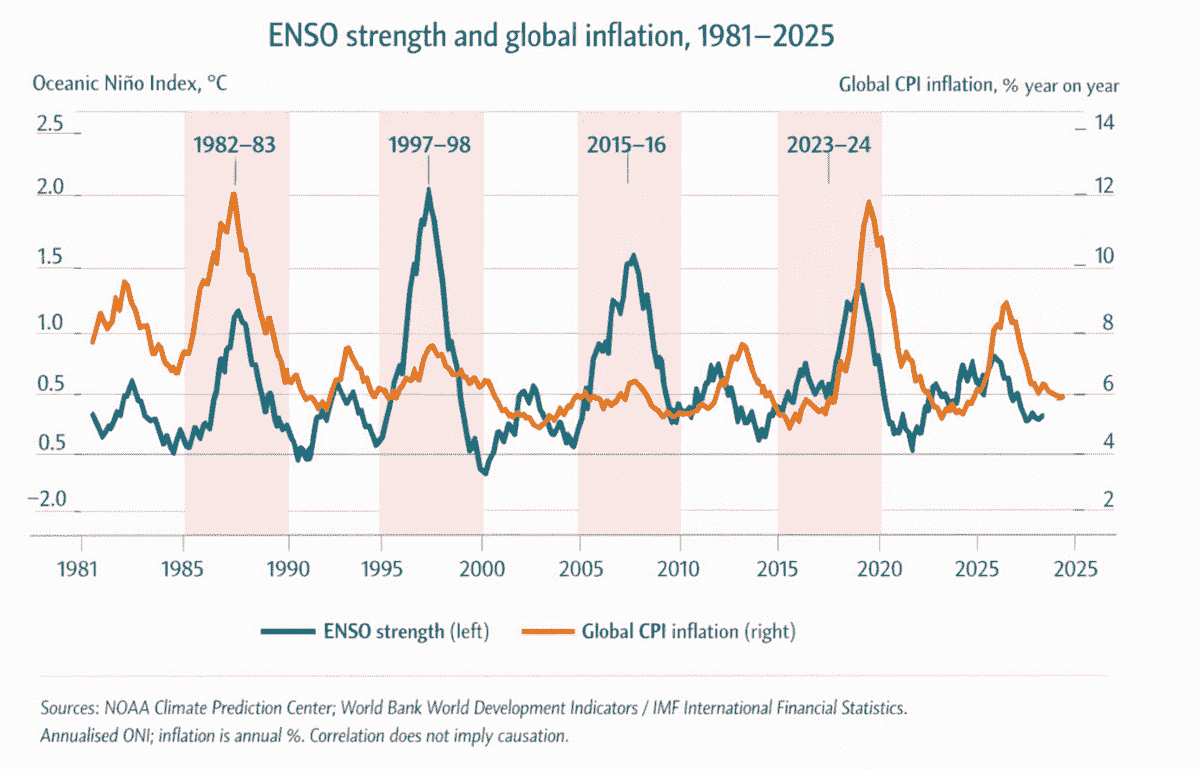
The US National Oceanic and Atmospheric Association (NOAA) ranks 1982–83 and 1997–98 among the strongest El Niño events on record. A 2023 study by Callahan and Mankin, estimated that these events were associated with global income losses of US$4.1 trillion and US$5.7 trillion respectively, with effects that lasted beyond the event year. The current episode is expected to be even more powerful.
Studies by the International Monetary Fund found that stronger El Niño conditions can push up commodity prices. One typical increase in strength was linked to a 3.5–4 percentage point rise in commodity-price inflation. El Niño also accounted for part of the movement in global inflation and economic activity, although the effects varied widely between countries.
Source: IEA
While strong El Niño episodes have sometimes coincided with higher inflation, weather is rarely the only factor at work. Energy shocks, currencies, trade restrictions and monetary policy can all influence the eventual economic outlook.
In today's environment of geopolitical tensions, supply-chain disruption and elevated government debt, an additional weather-related shock could add further pressure to already complex economic conditions.
Markets often react to the consequences of El Niño before those effects become visible in economic data. Rather than focusing on weather forecasts, investors may want to watch for signs that disruption is feeding through to the wider economy.
The key question for investors is not whether temperatures rise in the Pacific Ocean, but whether those changes alter the outlook for inflation, interest rates, company earnings or economic growth.
1. Commodities
Agricultural commodities are often among the first markets to react to changing weather conditions. But the impact can vary by crop, region, and even by producer. Coffee, cocoa, sugar, palm oil, grains and animal feed all have different growing seasons and weather risks, for example. There may also be opportunities from producers who diversify into crops that are more climate resilient, or can benefit from the temporary climate shift
2. Bonds and currencies
For bond investors, the key issue is whether higher food and commodity prices remain temporary or contribute to more persistent inflation. If inflation proves stickier than expected, markets may need to reassess the path of interest rates. Currency effects can also differ, with some food-importing emerging economies with weak currencies potentially more exposed than major commodity exporters with strong harvests or favourable rainfall.
3. Equities
The implications for equities extend well beyond agriculture. Food manufacturers, supermarkets and restaurants face input-cost and pricing decisions. Utility companies may see shifts in hydroelectric output and cooling demand. Mining firms may encounter water or transport disruption. Insurers may see catastrophe claims. Logistics firms can be affected by floods, drought or altered river levels. Companies with diversified supply chains, pricing power and strong balance sheets may be better placed to navigate disruption.
The investment lesson from El Niño is less about predicting the weather and more about preparing for uncertainty. While particular sectors or regions may benefit, the overall effects are difficult to forecast and often uneven. That reinforces the case for diversification across regions, sectors and asset classes, reducing reliance on any single economic outcome. For investors, the focus should be on portfolio resilience rather than trying to anticipate every twist and turn in a complex climate event.
Key takeaways
A powerful El Niño is economically relevant because it can create multiple, but uneven, supply shocks. History suggests this can influence commodity prices, inflation and growth, although the effects vary significantly between countries, sectors and asset classes. While the outcomes are difficult to predict, investors can improve portfolio resilience by:
Rather than trying to predict the precise path of the event, investors may be better served by focusing on how changing weather conditions feed through to economic activity, corporate earnings and market expectations. While El Niño is a global phenomenon, its investment implications are likely to be highly selective, creating both risks and opportunities across markets.